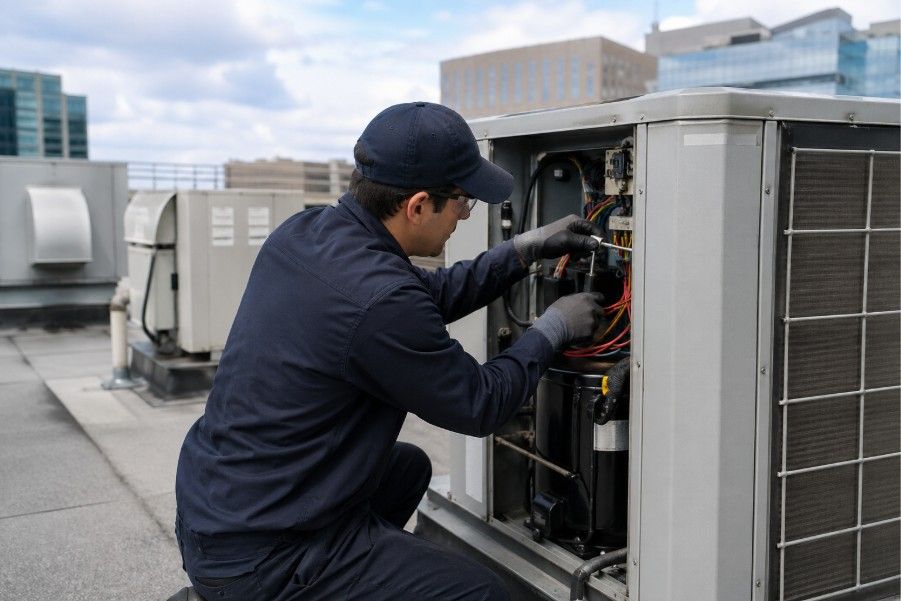
Preventive maintenance is a foundational component of effective facility management. For organisations operating across multiple provinces, maintaining consistent maintenance practices can be challenging due to regional differences in climate, regulations, and operational demands.
Establishing preventive maintenance standardization in Canada allows facility directors to create structured, repeatable processes while still accommodating provincial variability. A standardised approach helps ensure that assets are maintained consistently, compliance requirements are supported, and operational disruptions are minimized.
However, standardisation does not mean rigid uniformity. In Canada, where environmental conditions and regulatory expectations differ across provinces, preventive maintenance programmes must balance consistency with flexibility.
Facility Network supports national facility operations by designing and managing preventive maintenance frameworks, coordinating vendor networks, and aligning maintenance practices across diverse locations.
This guide explores preventive maintenance standardization in Canada, focusing on PM calendar alignment, seasonal adjustments, and asset lifecycle considerations relevant to multi-site operations.
Standardizing preventive maintenance processes offers several operational advantages.
Standardization ensures that maintenance activities are performed consistently across facilities.
Regular and structured maintenance supports reliable asset performance.
Standardised processes help align maintenance practices with applicable regulations, where required.
Consistency reduces duplication of effort and simplifies coordination.
For facility directors, preventive maintenance standardization in Canada is a key strategy for managing complex portfolios.
Canada’s geographic diversity has a direct impact on maintenance requirements.
Weather conditions vary significantly across provinces, influencing maintenance needs.
Seasonal changes affect equipment performance and facility conditions.
Maintenance requirements may be influenced by provincial standards and guidelines.
Different facility types may require tailored maintenance approaches.
Recognizing these factors is essential when implementing preventive maintenance standardization in Canada.
A national framework provides the foundation for standardised maintenance practices.
Organizations should define core maintenance activities that apply across all locations. To ensure technical consistency, national frameworks should be anchored in the SFG20 (Standard Maintenance Specification), adapted to meet the National Building Code of Canada and provincial safety requirements.
Guidelines should allow for regional adjustments based on local conditions.
Centralised teams can oversee maintenance planning and execution.
Maintenance frameworks should align with broader operational strategies.
A structured framework supports effective preventive maintenance standardization in Canada.
Aligning maintenance schedules across provinces is a key aspect of standardization.
Organizations should develop a baseline PM calendar that outlines routine maintenance activities.
Schedules should be coordinated to ensure consistency while accommodating regional needs.
Maintenance activities should align with operational demands and facility usage.
PM calendars should be reviewed and updated regularly.
Effective calendar alignment strengthens preventive maintenance standardization in Canada.
Seasonal conditions play a significant role in maintenance planning.
Cold temperatures and snow can affect building systems and equipment.
Spring often requires inspection and maintenance following winter conditions.
Warmer months may present opportunities for certain maintenance activities.
Autumn is often used to prepare facilities for winter conditions.
Incorporating seasonal adjustments is essential for preventive maintenance standardization in Canada.
Preventive maintenance programmes often intersect with compliance requirements.
Certain systems may require maintenance to support compliance, where applicable.
Maintenance activities should be documented to demonstrate alignment with requirements.
Maintenance schedules should align with inspection requirements.
Ongoing monitoring helps ensure that compliance related maintenance is maintained.
Integrating compliance considerations strengthens preventive maintenance standardization in Canada.
Vendors play a critical role in executing maintenance programmes.
Organizations should select vendors capable of meeting maintenance standards.
Vendors should follow consistent procedures across locations.
Clear communication supports alignment between vendors and facility teams.
Organizations should monitor vendor performance to ensure quality and consistency.
Vendor coordination is essential for preventive maintenance standardization in Canada.
Technology can enhance preventive maintenance programmes.
These systems track maintenance activities and schedules.
Automation helps ensure that maintenance tasks are performed on time.
Analytics provide insights into maintenance performance and trends.
Integration improves coordination across operations.
Technology supports efficient preventive maintenance standardization in Canada.
Multi-site operations require coordinated management approaches.
Centralised teams provide visibility and control over maintenance activities.
Standardised processes ensure consistency across locations.
Processes should allow for adjustments based on local conditions.
Effective communication supports coordination between sites.
Managing multi-site operations effectively supports preventive maintenance standardization in Canada.
Preventive maintenance is closely linked to risk management.
Regular maintenance helps reduce the likelihood of equipment failures.
Maintenance activities support safe facility operations.
Preventive maintenance reduces unexpected operational disruptions.
Consistent maintenance improves overall system reliability.
A proactive approach supports preventive maintenance standardization in Canada.
Preventive maintenance programmes should evolve over time.
Regular reviews help assess the effectiveness of maintenance activities.
Feedback from facility teams and vendors supports improvements.
Maintenance data can inform adjustments to schedules and processes.
Programmes should adapt to changes in operations, regulations, and technology.
Continuous improvement strengthens preventive maintenance standardization in Canada.
Managing preventive maintenance across multiple provinces can be complex. Many organizations partner with facility management providers to support these efforts.
Facility Network assists organizations by:
Their expertise in multi-site operations helps organizations maintain consistent preventive maintenance standardization in Canada while adapting to regional requirements.
Facility directors can strengthen maintenance programmes by following best practices.
Create consistent maintenance standards across locations.
Allow for flexibility based on local conditions.
Leverage systems for scheduling and tracking.
Track maintenance outcomes and adjust as needed.
Work closely with vendors to ensure alignment.
These practices support effective preventive maintenance standardization in Canada.
Standardizing preventive maintenance across provinces is essential for managing complex facility portfolios in Canada. By balancing consistency with flexibility, organizations can create maintenance programmes that support asset performance, compliance alignment, and operational efficiency.
Through structured frameworks, aligned PM calendars, and coordinated vendor networks, facility directors can achieve consistent maintenance outcomes across diverse environments.
Partnering with Facility Network further enhances these efforts by coordinating maintenance activities, managing vendor networks, and ensuring consistent execution across locations.
With a strong focus on preventive maintenance standardization in Canada, organizations can improve reliability, reduce operational risks, and maintain high standards across their facilities. Contact us to know more about our services.
What is preventive maintenance standardization in Canada?
It refers to creating consistent maintenance processes across facilities while allowing for regional adjustments.
Why is standardization important?
It ensures consistency, improves efficiency, and supports asset performance.
How do seasonal changes affect maintenance?
Seasonal conditions influence maintenance needs and scheduling.
What is a PM calendar?
A PM calendar outlines scheduled maintenance activities for assets and systems.
How can organizations manage maintenance across multiple sites?
Through centralised oversight, standardised processes, and effective vendor coordination.
What role does technology play in preventive maintenance?
Technology helps track schedules, monitor performance, and improve coordination.
How does Facility Network support maintenance programmes?
Facility Network helps design frameworks, coordinate vendors, and manage maintenance schedules across Canada.