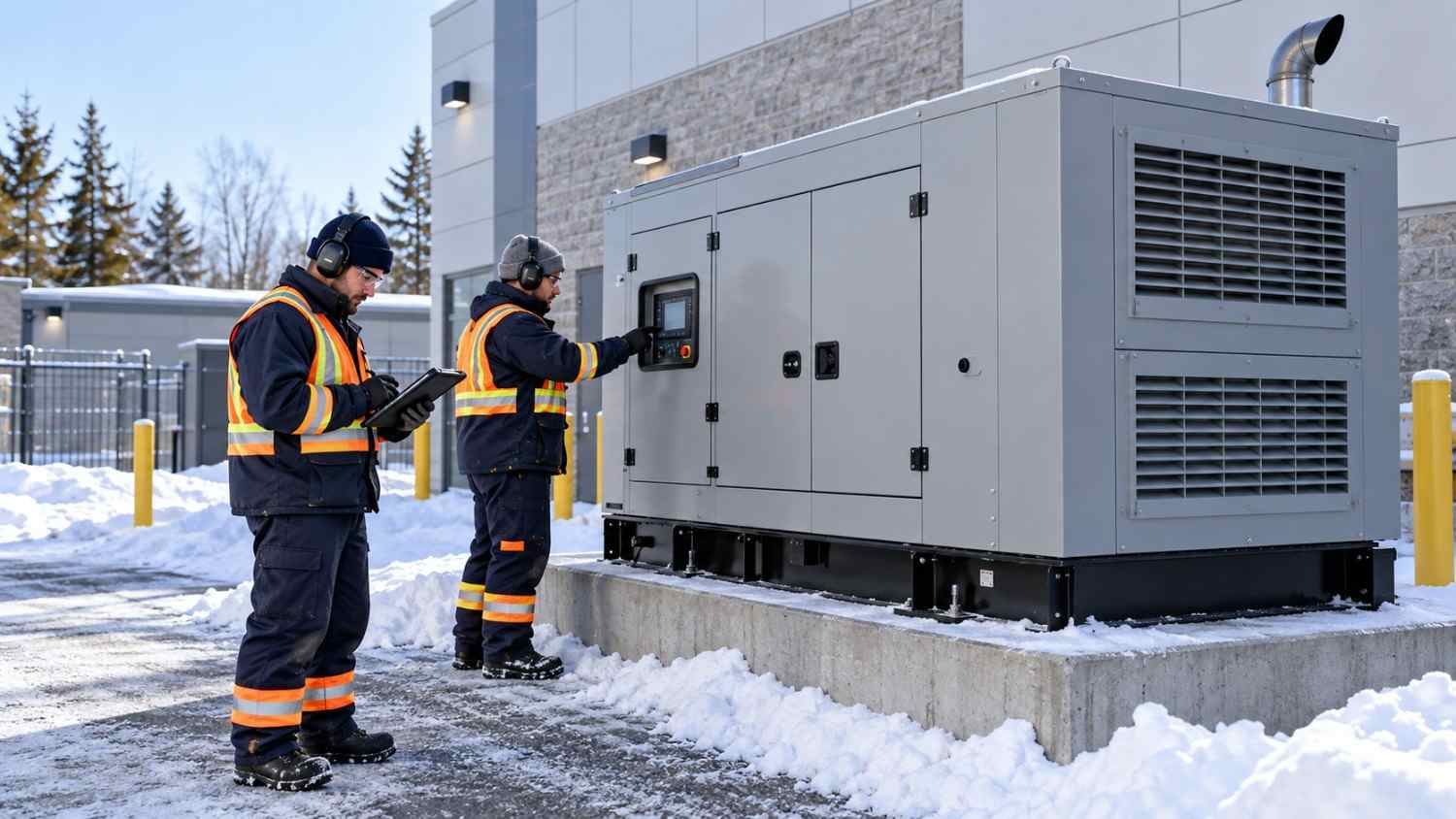
Extreme cold can place unusual pressure on commercial facilities across Canada. A prolonged outage can affect heating, fire protection systems, security equipment, communications, access controls, pumps, refrigeration, building automation and other critical systems. For facility directors, property managers and risk teams, backup power should therefore be treated as part of a broader winter resilience programme rather than as a standalone generator exercise.
At Facility Network, we approach winter readiness through structured planning, clear ownership, preventive maintenance and documented service verification. Our experience supporting facilities across Canada helps us understand why a backup power plan that works for an urban site in Ontario may need a different operating approach for a remote facility in Alberta, northern Manitoba or Atlantic Canada. Our national operating model is built around accountability, coordination and visibility across multiple locations.
The goal is not simply to have a generator available. Teams need to know which assets require power, how backup systems are maintained, who responds when an outage occurs, how fuel and access are managed, and what evidence confirms that critical preparations were completed.
Extreme cold backup power readiness is the process of preparing generators, transfer equipment, critical electrical systems, fuel arrangements, facilities and response teams to maintain essential operations during a winter power interruption.
A useful programme connects five areas:
This approach helps facility teams move from reactive response to planned winter risk controls.
The exact requirements will depend on the building, occupancy, equipment, jurisdiction and applicable standards. The National Building Code of Canada 2025 is a national model code, and its provisions only have legal effect when adopted by the relevant jurisdiction. The National Research Council of Canada advises facility stakeholders to confirm applicable requirements with the appropriate provincial or territorial authority.
A power interruption during mild weather can create inconvenience. During severe winter conditions, the same interruption can become a broader operational issue.
Heating systems may stop functioning. Building automation systems can lose control. Water systems can become vulnerable to freezing. Security systems may operate on limited battery capacity. Doors, gates and elevators may be affected. Refrigeration and temperature-sensitive operations may also require rapid intervention.
The risk is particularly significant for multi-site organisations because facilities can experience different weather conditions and infrastructure challenges at the same time.
A winter readiness programme should therefore consider:
This is where facility governance in Canada becomes important. A central standard can establish the expected process, while individual sites may require different controls based on local conditions.
Before testing backup equipment, facility teams should determine what actually needs to remain operational.
Not every electrical load requires generator support. A critical power assessment can divide building systems into categories based on their operational importance.
For example:
The assessment should also identify dependencies. A generator may provide power to a heating control panel, for example, but that does not automatically mean the entire heating system can operate during an outage.
Documenting these relationships creates a clearer maintenance record and supports more practical escalation decisions.
Generators and associated equipment should not receive attention only when a severe weather warning appears.
Preventive maintenance planning should establish recurring activities based on the equipment manufacturer's requirements, site conditions, applicable standards and the organisation's risk tolerance.
A winter preparation schedule may include:
The exact testing frequency and technical procedure should be established by qualified personnel and applicable requirements rather than by a generic national schedule.
A central maintenance programme can then track whether each facility has completed the required preparation and whether outstanding deficiencies have been addressed.
For organisations managing multiple properties, this supports consistent multi-site maintenance standards without assuming that every building has identical equipment or risk exposure.
A generator should be evaluated against the loads it is expected to support.
Facility teams should maintain an up-to-date record of:
Load requirements can change when a facility is renovated, repurposed or fitted with new equipment.
This makes change management an important part of backup power governance. A generator assessment from several years ago may not accurately reflect the facility's current electrical configuration.
Teams should also document who owns the responsibility for reviewing load changes and updating emergency power records.
Generator readiness involves more than the electrical equipment itself.
Severe winter conditions can make fuel access difficult, particularly at rural or remote facilities. Snow accumulation may block access routes, while freezing temperatures can affect equipment, fluids and battery performance.
Facility teams should consider:
These considerations should be documented before winter rather than addressed for the first time during an outage.
Geography matters. A facility in Calgary may experience very different winter conditions from one in Halifax, Thunder Bay or Yellowknife. Regional winter planning should account for those differences rather than applying one identical response assumption to every site.
Backup power programmes can fail operationally when responsibilities are unclear.
A facility manager may assume the electrical contractor is monitoring the generator. The contractor may assume the facility team will schedule testing. Procurement may manage the contract but not receive technical deficiency reports.
A strong governance structure assigns ownership for each activity.
The names and roles will vary between organisations, but the principle remains consistent: every critical activity should have an accountable owner.
This supports operational consistency and makes escalation faster when conditions deteriorate.
Backup power readiness should also be reviewed alongside fire and life safety systems.
This is where a winter fire life safety inspection can become part of a wider seasonal readiness process. Facility teams should understand which fire alarm, emergency lighting, fire protection, communications and other life safety systems depend on normal or emergency electrical power.
Documentation should identify:
The National Fire Code and National Building Code are model codes, and the applicable requirements depend on local adoption and enforcement. Facility teams should confirm requirements with the authority having jurisdiction rather than assuming that a national model code automatically applies in the same form at every location.
Backup power and freeze protection are closely connected.
A generator may continue supplying electricity while a facility still faces freezing risk if critical heating, circulation or control equipment is not connected to the emergency supply.
Facility teams should therefore review:
The assessment should identify which systems require emergency power and which require independent freeze protection measures.
Our related resource, Freeze Protection Compliance For Commercial Buildings, can help teams consider the relationship between winter freeze risk, maintenance planning, documentation and jurisdiction-specific requirements.
A generator failure during a severe cold event requires more than a service call.
Teams should establish an escalation path before winter begins.
A practical escalation structure may include:
Level 1: Monitoring
A utility outage, generator alarm or temperature warning is detected.
Level 2: Site Response
The designated facility contact confirms conditions, checks critical systems and initiates the approved response procedure.
Level 3: Technical Escalation
The appropriate electrical, mechanical or generator service provider is contacted.
Level 4: Operational Escalation
If critical systems remain unavailable, facility leadership and risk teams are notified.
Level 5: Continuity Response
The organisation activates its applicable business continuity or emergency operating procedures.
Each level should specify who receives the notification, what information must be recorded and when the situation moves to the next level.
This is especially important for organisations with facilities operating outside standard business hours.
One of the most useful controls in multi-site winter preparation is documented verification.
Instead of recording that a facility is simply “winter ready”, teams should maintain evidence showing what was checked, when it was checked, who completed the activity and whether deficiencies remain open.
A useful readiness record can include:
This creates a more useful maintenance history and allows operations leaders to identify recurring issues.
Digital systems can make this information easier to consolidate. Our facility management technology and real-time visibility capabilities can support organisations that need clearer visibility across work orders, assets and service activity.
Workplace safety responsibilities vary according to jurisdiction.
Part II of the Canada Labour Code applies to federally regulated workplaces and establishes occupational health and safety responsibilities for employers and employees in those workplaces. Federal guidance also identifies responsibilities around information, training, supervision, inspections and hazard prevention.
Facilities outside federal jurisdiction generally need to consider the applicable provincial or territorial occupational health and safety framework.
For a multi-site portfolio, that means a single corporate procedure may need jurisdiction-specific implementation notes.
Contractor documentation should also be reviewed according to the province involved. For example, Ontario organisations may need to verify applicable WSIB clearance requirements when engaging contractors. WSIB states that a clearance indicates that a registered business, contractor or subcontractor is registered and up to date with WSIB requirements.
The same principle applies elsewhere in Canada, but terminology, requirements and processes can differ between workers' compensation authorities.
A central dashboard can help facility leaders move from individual site updates to portfolio-level visibility.
Useful dashboard fields may include:
A simple status structure can distinguish between complete, in progress, blocked and requiring escalation.
The objective is not to create another administrative layer. It is to give decision-makers a clearer view of unresolved risks before extreme weather affects operations.
For organisations managing facilities across different sectors, our facility services by industry approach can also help frame winter readiness around the operational characteristics of each facility type.
Canada's geography makes regional planning essential.
A winter backup power programme should consider local conditions such as:
Alberta and parts of British Columbia can experience rapid temperature changes, severe cold, snow events and freeze-thaw conditions. Sites should consider how changing temperatures affect access, equipment and emergency response.
Ontario and Québec facilities may encounter heavy snowfall, freezing rain and freeze-thaw cycles. Urban congestion can also affect contractor travel and emergency access.
Nova Scotia, New Brunswick, Prince Edward Island and Newfoundland and Labrador can experience winter storms, freezing rain, coastal weather and difficult travel conditions.
Facilities in northern and remote communities may face longer travel distances, limited contractor availability and more challenging supply logistics.
These differences affect staffing, service frequency, response planning and service-level expectations. A national programme can establish common governance while still allowing site-specific controls.
Winter readiness documentation should remain useful after the event.
A strong record can help teams answer questions such as:
This supports continuous improvement and gives risk teams a factual record of decisions and actions.
Facility teams can also use our Facility Network facility management resources to support broader planning around maintenance governance, operational documentation and multi-site facility management.
Post-event review is often where organisations find the most useful improvement opportunities.
After a significant outage or extreme cold event, review:
Do not limit the review to equipment failure.
A generator may perform correctly while the wider response still reveals weaknesses in communication, access, escalation or documentation.
The resulting lessons should feed back into preventive maintenance planning and the next winter readiness cycle.
At Facility Network, we focus on connecting maintenance activity with operational accountability. We support organisations managing complex facility portfolios by coordinating services, maintaining visibility across work activity and helping teams establish consistent processes across locations.
We have more than 40 years of experience, and our About page states that we support more than 10,000 facilities across 2,500 cities and towns. Our coast-to-coast operating model provides a single point of contact for organisations that need coordinated facility support across multiple Canadian locations.
For facility leaders, the value of this approach is not simply having another service provider. It is having clearer ownership, structured coordination and documented visibility across the maintenance activities that support winter operations.
Before the winter season, facility teams should confirm:
This checklist should be adapted to the facility's equipment, occupancy, risk profile and applicable requirements.
Extreme cold can expose weaknesses that remain hidden during normal operating conditions. Backup power planning therefore needs to sit within a wider framework of preventive maintenance, facility governance, emergency escalation and documented verification.
For Canadian organisations managing multiple sites, the practical challenge is maintaining consistent standards while accounting for local weather, equipment, jurisdictional requirements and operational conditions. National model codes provide an important reference point, but the applicable provincial, territorial and municipal requirements must be confirmed for each facility.
At Facility Network, we help organisations bring maintenance coordination, operational visibility and accountability together across complex facility portfolios. If your organisation is reviewing its winter risk controls, backup power programme or multi-site maintenance processes, you can contact Facility Network to discuss your facility requirements and operating environment.
What Should Canadian Facility Teams Know About Extreme Cold Backup Power Readiness?
Teams should identify critical electrical loads, verify generator and transfer equipment, review fuel and access arrangements, confirm emergency contacts, establish escalation procedures and maintain documented verification. Requirements should also be checked against the applicable provincial, territorial, municipal and occupational health and safety frameworks.
How Often Should Backup Generators Be Tested Before Winter?
There is no single testing frequency that applies to every Canadian facility. Teams should follow applicable requirements, equipment manufacturer instructions, service recommendations and the facility's risk management programme. Qualified professionals should determine appropriate testing procedures.
What Equipment Should Be Prioritised During A Winter Power Assessment?
Start with systems whose loss could create significant life safety, freeze, security, operational or continuity risks. This may include heating controls, pumps, fire and life safety systems, emergency communications, security equipment and selected building automation systems.
Does The National Building Code Of Canada 2025 Apply Automatically To Every Facility?
No. The National Building Code of Canada 2025 is a national model code. It must be adopted by the applicable regulatory authority before it has legal effect in a jurisdiction. Facilities should confirm the applicable code edition and requirements with the relevant provincial or territorial authority.
How Does A Winter Fire Life Safety Inspection Relate To Backup Power?
A winter fire life safety inspection can include reviewing systems that depend on normal or emergency electrical power. Teams should understand applicable requirements for emergency lighting, fire alarm systems, communications and other relevant life safety equipment and maintain records of inspections, testing and deficiencies.
What Documentation Should Be Maintained For Backup Power?
Records can include service reports, inspection dates, testing results, generator identification, deficiencies, corrective actions, responsible parties and verification dates. Maintaining this information centrally can improve visibility across a multi-site portfolio.
Why Is Regional Planning Important For Canadian Facilities?
Winter conditions differ significantly between provinces, territories and communities. Snowfall, freezing rain, extreme cold, freeze-thaw cycles, travel distances and contractor availability can affect service frequency, staffing and emergency response.
Do Occupational Health And Safety Requirements Differ Across Canada?
Yes. Part II of the Canada Labour Code applies to federally regulated workplaces, while other workplaces are generally subject to applicable provincial or territorial occupational health and safety legislation.
Should Backup Power Be Included In A Multi-Site Maintenance Programme?
Yes. Including backup power within the broader maintenance programme can help teams coordinate inspections, corrective actions, documentation and escalation across locations. Site-specific requirements should still be maintained where equipment or operating conditions differ.
How Can Facility Teams Improve Winter Readiness Documentation?
Use standard fields for inspections, testing, deficiencies, ownership, corrective actions and verification. A central work order or facility management system can make it easier to monitor outstanding tasks and compare readiness across multiple facilities.