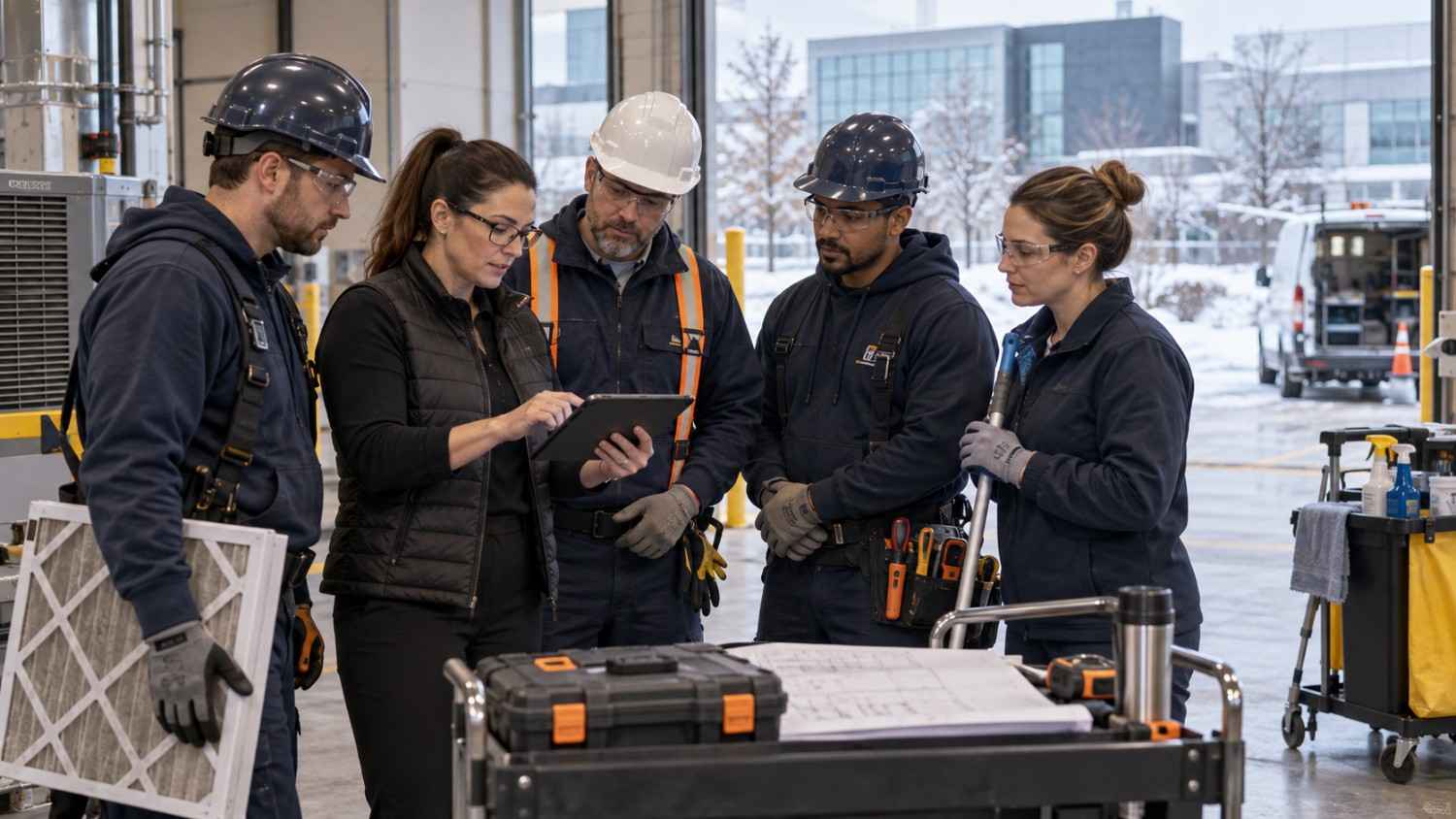
Some equipment failures occur without warning. Others are preceded by recurring faults, declining performance, or inspection findings. A planned maintenance process helps facility teams track those signals and decide what needs attention.
For organizations managing commercial facilities, the challenge is recognizing those signals and acting before they become operational problems.
A structured preventative maintenance program gives facility teams a framework for planning inspections, servicing equipment, documenting completed work and addressing developing issues before they require an unplanned response.
For multi-site organizations, the value extends beyond individual equipment. A coordinated program can help operations teams establish consistent maintenance practices, improve asset visibility and create clearer accountability across locations.
The goal is not to eliminate every breakdown. No maintenance strategy can guarantee that. The goal is to make facility maintenance more planned, visible and manageable.
A preventative maintenance program is a planned approach to maintaining facility assets before failures or significant problems occur.
Instead of waiting for equipment or building systems to fail, maintenance activities are scheduled based on factors such as:
Common preventative maintenance activities can include:
The specific maintenance schedule should be based on the asset, facility and applicable requirements rather than applying the same checklist to every building.
Reactive maintenance addresses a problem after it occurs. Preventative maintenance attempts to identify and address potential issues before they become more disruptive.
This distinction matters in commercial environments where an equipment failure can affect employees, customers, tenants, production, inventory or building access.
A planned maintenance approach can help organizations:
For facility managers, this can shift maintenance activity from constant reaction towards more structured planning.
A reliable asset inventory helps teams define what needs maintenance, who is responsible, and which assets need priority attention.
The first step is to establish a reliable asset inventory.
Depending on the facility, this may include:
For a multi-site portfolio, centralized asset information can make it easier to understand what equipment exists at each location and how maintenance requirements differ.
Not every asset requires the same maintenance priority. An organization should identify which assets have the greatest potential operational impact if they fail.
For example, an asset may be considered more critical if its failure could affect:
This allows facility teams to allocate maintenance resources based on operational importance.
Critical assets
Failure may create significant operational or safety consequences.
Important assets
Failure can disrupt facility operations but may have alternatives or workarounds.
Routine assets
Failure generally has a limited operational impact.
The categories should be tailored to each organization's facilities and risk profile.
One of the most common weaknesses in preventative maintenance is creating schedules that look comprehensive but are not operationally realistic.
Maintenance frequency should consider the actual asset and environment.
Factors may include:
For Canadian facilities, seasonal considerations can be particularly important.
Freeze-thaw cycles, snow, ice, temperature extremes and coastal exposure can affect different parts of a facility portfolio.
A maintenance schedule should therefore account for regional conditions where relevant.
Some maintenance activities need to occur at specific times of the year.
Examples can include:
A preventative maintenance program should make these activities visible before the relevant season arrives.
This is particularly important for organizations operating across multiple Canadian regions because seasonal timing and weather exposure can differ significantly.
A maintenance schedule is only useful when scheduled tasks become actual work.
A planned maintenance workflow can include:
Task scheduled → Work order created → Technician assigned → Service completed → Findings documented → Completion verified → Follow-up scheduled
This connects preventative maintenance with broader work-order management.
It also creates a record that facility teams can use when reviewing asset history.
Facility Network combines internal field technicians, qualified managed vendor partners, and centralized oversight to coordinate commercial facility services across Canada, including HVAC and refrigeration, electrical, plumbing, roofing, snow clearing, and emergency services.
"Maintenance completed" is often not enough information for future decision-making.
Technicians may identify conditions that require monitoring, further repair or investigation.
Useful documentation can include:
This information helps preserve facility knowledge.
It can also help identify patterns across locations.
If several facilities are reporting similar equipment problems, operations teams may want to investigate whether the issue is related to asset age, installation, maintenance practices or another factor.
Preventative maintenance should not operate separately from reactive maintenance.
Work-order history can provide useful information for refining the program.
For example, if an asset repeatedly requires emergency repairs between scheduled services, the organization may need to review:
The answer will not always be to increase maintenance frequency.
The purpose of reviewing history is to understand whether the current maintenance approach is appropriate.
Multi-site organizations face a particular challenge: every facility may have developed its own maintenance habits.
One location may maintain detailed equipment records while another relies on paper files. One site may have a formal inspection schedule while another relies primarily on reactive service.
A centralized preventative maintenance program can establish common expectations for:
However, standardization should not mean identical maintenance schedules.
Each location may require different tasks based on building systems, climate, equipment and operational use.
Preventative maintenance frequently involves external service providers.
Facility teams should define what vendors are expected to provide after completing scheduled work.
Clear documentation expectations make it easier to verify that scheduled maintenance actually occurred.
They can also support more informed vendor-performance reviews.
For enterprise portfolios, vendor qualification and coordination become increasingly important as the number of locations and service providers increases.
A maintenance program should provide visibility into whether scheduled tasks are actually being completed.
Teams can monitor:
This allows facility managers to identify gaps in program execution.
If planned maintenance is repeatedly deferred, the issue may not simply be technician availability. The organization may need to review scheduling, budget allocation, asset priorities or operational constraints.
Preventative maintenance should support business operations rather than unnecessarily interfere with them.
For commercial facilities, service may need to be coordinated around:
Planned maintenance gives facility teams an opportunity to schedule work proactively.
That can be particularly valuable for organizations where an unplanned shutdown or restricted access could create significant operational consequences.
Technology can support the administration of a preventative maintenance program by connecting scheduled tasks with work orders, asset records and service documentation.
Useful capabilities may include:
Facility Network highlights digital asset tagging, work-order management, real-time tracking, analytics and service documentation within its technology-enabled approach.
The technology should support the organization's maintenance workflow rather than become an additional administrative layer.
A central calendar can make upcoming maintenance easier to manage across a facility portfolio.
The following are planning categories, not recommended service intervals. Assign actual tasks and frequencies using the relevant manufacturer guidance, asset condition, site requirements, and applicable inspection requirements.
Actual frequencies should always reflect manufacturer guidance, asset requirements, applicable regulations and site conditions.
A preventative maintenance program should evolve.
Facility teams should periodically review:
This review can identify whether maintenance schedules remain appropriate.
A building that changes occupancy or operating hours may require a different maintenance approach. Similarly, new equipment or capital improvements may require updates to the program.
A checklist that ignores asset type, condition and site requirements may have limited operational value.
Completing scheduled tasks matters, but the findings from those tasks are also important.
Repeatedly postponing tasks can create a growing maintenance backlog.
Both types of activity provide useful information about facility and asset condition.
A national program should provide consistent processes while allowing site-specific maintenance requirements.
Organizations reviewing their current program can start with a practical assessment.
The answers can highlight where the existing program needs greater structure or visibility.
A preventative maintenance program should not be viewed simply as a schedule of recurring inspections.
It is an operational framework that connects asset information, maintenance planning, work orders, technicians, vendors, documentation and reporting.
When these elements work together, facility teams can identify developing issues earlier, plan service around business requirements and build a stronger record of asset condition.
For multi-site organizations, the challenge is even greater because the program must work across different buildings, regions, equipment and operating environments.
A coordinated approach can provide a consistent management framework while allowing individual facilities to respond to their own conditions.
Facility Network provides commercial facility services across Canada and supports organizations with maintenance, emergency services and other facility requirements. Explore Facility Network's services to learn more about its commercial service capabilities.
If your organization is reviewing its maintenance program or looking for a more coordinated approach across multiple facilities, contact Facility Network to discuss your requirements.
1. What is a preventative maintenance program?
A preventative maintenance program is a structured plan for inspecting, servicing and maintaining facility assets before failures or significant problems occur. It uses factors such as asset condition, manufacturer guidance, usage and site requirements to determine appropriate maintenance activities.
2. How does preventative maintenance help reduce facility disruptions?
Planned inspections and servicing can help identify developing issues before they become more disruptive. While preventative maintenance cannot eliminate every unexpected failure, it can support earlier intervention and more organized maintenance planning.
3. What should be included in a preventative maintenance program?
A program may include asset inventories, maintenance schedules, work orders, inspections, service documentation, vendor requirements, completion tracking, escalation procedures and periodic program reviews.
4. Should every facility use the same preventative maintenance schedule?
No. Organizations can standardise the management process while adapting maintenance schedules to individual assets, building systems, climate, operating conditions and applicable requirements.
5. How often should preventative maintenance be performed?
There is no universal frequency. Maintenance intervals should reflect manufacturer recommendations, asset condition, usage, environmental conditions, operational requirements and applicable inspection or regulatory requirements.
6. How does technology support preventative maintenance?
Technology can help teams schedule maintenance, create work orders, track completion, maintain asset records, collect technician documentation and generate reports. The specific capabilities required depend on the organization's operational model.
7. How can facility teams tell whether their preventative maintenance program is effective?
Teams can review maintenance completion, overdue and deferred tasks, recurring service requests, emergency work, asset condition, documentation quality and vendor performance. These indicators can help identify where the program may need adjustment.