In the 2026 operational landscape, national facility management has evolved beyond physical maintenance into a data-driven governance function.
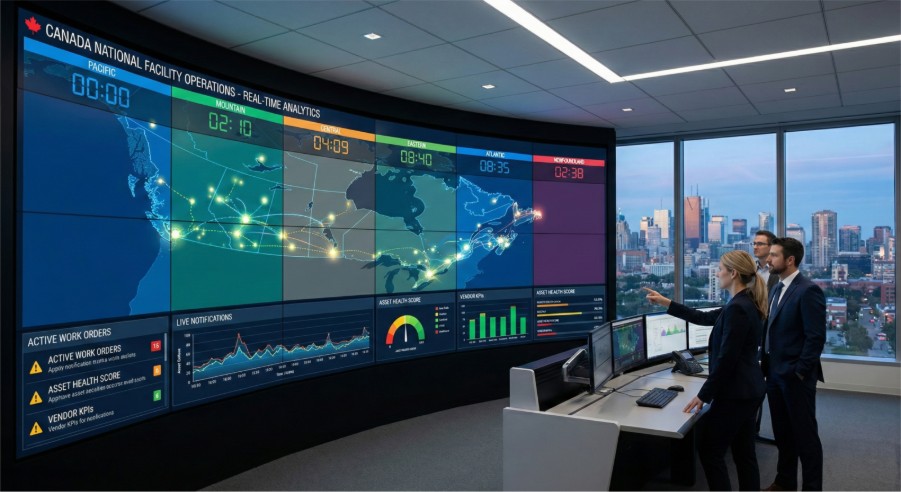
From British Columbia to Newfoundland and Labrador, Canadian operations span up to six time zones (Pacific, Mountain, Central, Eastern, Atlantic, and Newfoundland). Without a unified data framework, facility performance visibility becomes fragmented, delayed, and reactive. This is where real time facility data Canada becomes a foundational capability rather than a technology upgrade.
At Facility Network, national portfolios are supported through centralised operational oversight models that combine real-time visibility, coordinated service delivery, and governance aligned with Canadian operational realities. This article explores how enterprise operations leaders can leverage real time facility data Canada to manage distributed assets more effectively while maintaining consistency, accountability, and uptime across every location.
Canada’s geographic scale introduces operational challenges that are often underestimated at the planning stage. Facilities may operate under a single corporate strategy, but execution occurs across multiple time zones with varying business hours, service windows, and escalation timelines.
Time zone separation affects more than scheduling. It directly influences:
When facility data is delayed or siloed by region, leadership decisions are often made based on incomplete information. This disconnect increases operational risk, particularly during critical incidents or high-volume service periods.
Real time facility data Canada addresses this challenge by aligning operational signals across regions into a single, continuously updated framework.
Real time facility data is often misunderstood as simply faster reporting. It represents something broader: the ability to observe, measure, and act on facility performance across all locations as events unfold.
In more advanced environments, facilities typically leverage IIoT (Industrial Internet of Things) sensors and edge computing to facilitate live building diagnostics and predictive maintenance alerts. Effective real-time facility environments typically integrate:
Rather than relying on periodic reporting cycles, operations teams can see conditions as they develop, regardless of local time differences.
This shift from retrospective reporting to live operational awareness is essential for managing facilities across Canada’s time zones.
Traditional facility oversight models rely heavily on after-the-fact reporting. While useful for trend analysis, this approach limits an organisation’s ability to intervene early.
Real time facility data Canada enables a transition to continuous operational awareness, allowing leaders to detect deviations before they escalate.
With real-time insight, organisations can:
This proactive posture supports higher uptime and stronger risk control across national portfolios.
Operational leaders generally recognise that raw data requires a structured analytical layer to provide actionable intelligence.
Facility analytics frameworks often include:
When applied consistently, analytics help operations leaders understand not only what is happening, but why it is happening and where intervention is required.
In geographically distributed portfolios, analytics ensure that decisions remain evidence-based regardless of time zone.
Real-time frameworks are designed to support dynamic KPI tracking, reducing the 'data-lag' inherent in manual reporting cycles. Key performance indicators remain essential for accountability, but their effectiveness depends on how accurately and consistently they are tracked.
In national operations, KPIs often suffer from:
These gaps reduce confidence in performance data and limit its usefulness.
Real time facility data Canada supports KPI tracking that is:
This ensures that leadership teams can assess performance accurately, regardless of when or where activity occurs.
One of the most impactful applications of real time facility data Canada is the creation of national dashboards that consolidate information from every site.
Well-designed dashboards deliver:
By eliminating fragmented reporting systems, dashboards create a single operational narrative that supports faster and more confident decisions.
Work order management becomes significantly more complex when sites operate on different schedules.
Without real-time coordination, organisations experience:
Real time facility data Canada enables work order systems that adjust dynamically to local time while remaining visible nationally.
Vendor performance is a critical variable in facility outcomes. When oversight is delayed, accountability weakens.
Real time facility data Canada allows organisations to:
This level of transparency strengthens vendor accountability across all regions, regardless of time zone differences.
Assets represent long-term investments, and their performance directly impacts operational continuity.
Real-time asset visibility supports:
When asset data is accessible nationally, maintenance decisions can be prioritised based on real-time risk rather than regional reporting delays.
Manual reporting processes struggle to scale across national operations.
Real time facility data Canada enables reporting automation that:
Automation ensures that leadership teams receive accurate, timely information without manual intervention.
Enterprise leaders require confidence in the data that informs strategic decisions.
Real time facility data Canada ensures that executive decisions are grounded in current conditions rather than historical snapshots.
In distributed Canadian portfolios, time zone variability is typically viewed as a strategic variable rather than a mere scheduling hurdle.
Effective facility strategies account for:
Real-time data platforms remove many of the friction points created by time zone separation.
Maintaining real-time visibility is a primary requirement for organisations pursuing ISO 41001 (Facility Management) certification, the global benchmark for structured facility governance. Operational risk increases when issues remain invisible.
By maintaining continuous awareness, organisations reduce both operational and reputational risk.
As portfolios expand, data complexity increases.
Real time facility data Canada supports growth without sacrificing control or visibility.
Facility Network supports enterprise organisations through integrated oversight models that prioritise real-time visibility, national consistency, and operational accountability.
By combining data-driven coordination, vendor governance, and centralised reporting, Facility Network helps organisations manage facilities across Canada’s time zones with confidence and clarity.
Managing facilities across Canada’s time zones will always introduce complexity. However, complexity does not need to translate into risk or inefficiency.
By leveraging real time facility data Canada, organisations can unify oversight, improve decision-making, and maintain consistent performance across every location. From facility analytics and KPI tracking to national dashboards and automated reporting, real-time data transforms dispersed operations into a cohesive, resilient system.
With the right frameworks and partners in place, Canadian enterprises can turn geographic scale into an operational advantage rather than a limitation.
Contact us to know about our services in detail.
1. What is real time facility data Canada?
Real time facility data Canada refers to continuously updated operational data that provides live visibility into facility performance, work orders, assets, and vendors across Canadian locations.
2. Why is real-time data important for managing facilities across time zones?
It eliminates reporting delays, improves coordination, and ensures leadership has accurate visibility regardless of regional operating hours.
3. How does real-time facility data support KPI tracking?
It ensures KPIs are updated continuously, standardised nationally, and available through central dashboards for consistent performance monitoring.
4. Can real-time data improve vendor accountability?
Yes. Live tracking enables immediate visibility into vendor performance, SLA compliance, and response timelines across all locations.
5. How does Facility Network support real-time facility management?
Facility Network provides centralised oversight, data-driven coordination, and governance frameworks that help organisations manage multi-site facilities across Canada efficiently.
.jpeg)