Commercial facilities across Canada are under increasing pressure to improve operational efficiency, modernize infrastructure, and support broader environmental goals tied to sustainability and energy performance. As governments, organizations, and property stakeholders continue discussing long-term climate objectives, many facility managers are evaluating how day-to-day operational practices may help reduce greenhouse gas emissions Canada buildings generate through heating, cooling, lighting, and building operations.
Commercial buildings rely on complex systems that consume energy throughout the year. HVAC equipment, ventilation systems, lighting infrastructure, electrical systems, and building envelopes all influence how efficiently a property operates. Over time, aging infrastructure, deferred maintenance, inconsistent operational oversight, and inefficient scheduling may contribute to unnecessary energy strain and operational waste.
At Facility Network, we support organizations across Canada with coordinated commercial facility services delivered through a hybrid model that pairs our internal technicians with a managed network of vendor partners. This includes preventative maintenance planning, vendor management, infrastructure oversight, and operational support tailored to complex commercial environments. As discussions around greenhouse gas emissions from commercial buildings in Canada continue to evolve, many organizations are exploring practical ways facility management strategies can support operational efficiency and long-term sustainability planning.
This guide explores how proactive commercial facility management may help organizations address greenhouse gas emissions Canada buildings produce through operational activities, while supporting infrastructure reliability, occupant comfort, preventative maintenance, and long-term operational resilience.
Commercial facilities consume energy for a wide range of operational functions.
These may include:
The energy required to operate these systems may contribute to greenhouse gas emissions Canada buildings generate throughout the year, which large facilities may be required to track under frameworks like the federal Output-Based Pricing System (OBPS) or the Greenhouse Gas Reporting Program (GHGRP) overseen by Environment and Climate Change Canada (ECCC).
Commercial buildings play a significant role in national energy consumption and operational infrastructure demand across Canada.
Facilities operate under varying conditions depending on:
Because every property operates differently, strategies to reduce greenhouse gas emissions Canada buildings produce should always remain site-specific and operationally practical.
Facility management influences how commercial buildings operate on a daily basis.
Operational decisions may affect:
Proactive facility management often focuses on maintaining systems consistently rather than waiting for major infrastructure issues to emerge.
Commercial facilities that lack consistent operational coordination may experience:
Many organizations are recognizing that proactive facility management may help support broader environmental and operational objectives over time.
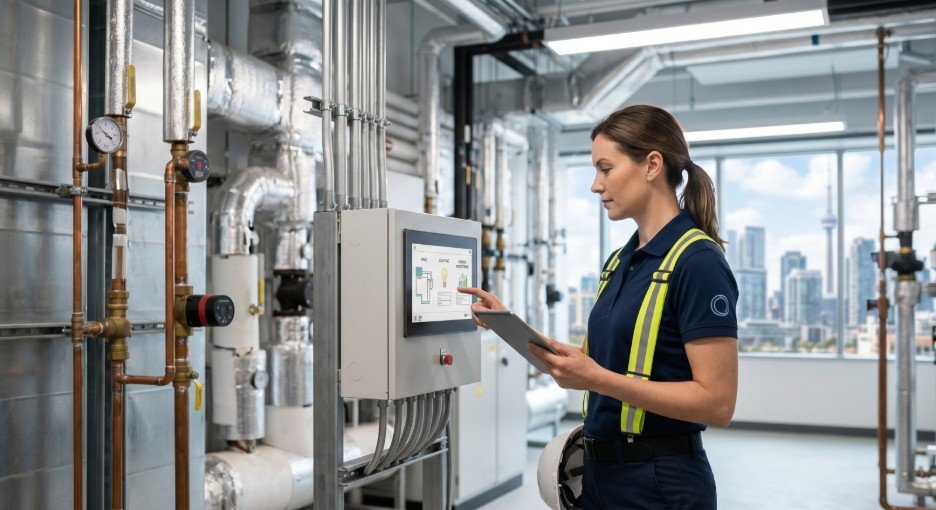
HVAC infrastructure is often one of the largest contributors to operational energy usage within commercial buildings.
Systems may include:
Poorly maintained HVAC systems may contribute to:
Preventative maintenance programs may support more stable system performance while helping organizations manage greenhouse gas emissions Canada buildings produce through heating and cooling operations.
Preventative maintenance is one of the most practical ways commercial organizations may support building efficiency over time.
Maintenance programs may include:
Routine servicing may help facilities:
Preventative maintenance should always reflect actual building conditions, equipment age, occupancy patterns, and operational demands.
Some commercial facilities are integrating building automation technologies to support operational monitoring and scheduling coordination.
These systems may assist with:
Building automation tools may provide greater operational visibility, but they should not be treated as universal solutions for every property.
Implementation decisions may depend on:
Technology adoption strategies should remain practical and aligned with actual facility requirements.
Lighting systems contribute significantly to operational energy use within commercial properties.
Facilities may review interior and exterior lighting schedules and controls, ensuring any infrastructure retrofits strictly adhere to the Canadian Electrical Code (CE Code) and align with the National Energy Code of Canada for Buildings (NECB) performance standards.
Older lighting infrastructure may present operational challenges related to:
Commercial lighting strategies should balance:
Facilities should avoid assuming that every property requires identical lighting configurations or automation systems.
Building envelopes play an important role in overall commercial building efficiency.
Facilities may evaluate:
Commercial properties across Canada experience:
Poor building envelope performance may increase heating and cooling demands, potentially affecting greenhouse gas emissions Canada buildings generate through operational energy use.
Ventilation systems help support indoor environmental conditions within commercial facilities.
Organizations may review:
Commercial facilities must balance:
Ventilation planning must reflect actual occupancy patterns while supporting alignment with the National Building Code of Canada (NBCC) and applicable CSA Group commercial ventilation guidelines.
Many organizations are increasing their focus on understanding how energy is used throughout commercial operations.
Facilities may review:
Operational visibility may help organizations identify:
Energy awareness strategies should support informed operational planning rather than relying solely on automated systems.
Organizations operating facilities across multiple provinces often face additional operational complexity.
Facilities may differ in:
Commercial organizations may encounter:
At Facility Network, we support organizations across Canada through coordinated facility services, preventative maintenance planning, operational oversight, and vendor management tailored to distributed commercial property portfolios.
Commercial infrastructure often performs more effectively when operational practices remain consistent.
Facilities may support system stability through:
Irregular system performance may contribute to:
Facilities that proactively review infrastructure conditions may be better positioned to identify potential concerns before they escalate.
Canadian commercial facilities face unique operational challenges throughout the year.
Facilities may experience:
Seasonal facility planning may include:
These operational reviews may help support building performance during changing weather conditions.
Many organizations are incorporating sustainability discussions into broader operational planning strategies.
Commercial facilities may review:
Effective sustainability planning should remain practical and operationally realistic.
Not every facility requires immediate large-scale infrastructure replacement or advanced technology implementation.
Operational improvement strategies should always reflect:
Commercial facility operations often involve multiple service providers and operational teams.
Organizations may coordinate:
Strong operational coordination may support:
At Facility Network, our team supports coordinated commercial facility operations across Canada through vendor management, preventative maintenance planning, infrastructure support, and operational oversight designed for complex commercial environments.
Many Canadian commercial properties operate within older buildings that may require phased modernization over time.
Facilities may encounter challenges related to:
Infrastructure upgrades often require balancing:
Commercial organizations should avoid assuming that all efficiency improvements require immediate large-scale renovations.
Facility documentation may support long-term operational planning and infrastructure management.
Organizations may maintain records related to:
Consistent documentation may help organizations:
Where required, facilities should coordinate with qualified professionals and applicable authorities regarding regulatory obligations and infrastructure considerations.
Commercial buildings must continue supporting comfortable and functional environments for occupants.
Facilities may prioritize:
Reducing greenhouse gas emissions Canada buildings generate should not compromise building usability or occupant comfort.
Organizations seeking to address greenhouse gas emissions Canada buildings produce often begin with operational assessments and preventative maintenance reviews.
Practical facility management strategies may include:
At Facility Network, we support organizations across Canada with coordinated commercial facility services, preventative maintenance planning, operational oversight, infrastructure support, and vendor management tailored to complex commercial property operations.
Reducing greenhouse gas emissions Canada buildings generate continues to be an important operational consideration for commercial organizations across the country.
As facilities review energy usage, HVAC performance, lighting infrastructure, preventative maintenance practices, and operational planning strategies, many organizations are focusing on practical approaches that support both sustainability discussions and long-term building performance.
Because commercial properties vary significantly in infrastructure condition, occupancy patterns, operational demands, and regional climate exposure, facility management strategies should always remain site-specific and operationally realistic.
At Facility Network, our team works with organizations across Canada to support coordinated commercial facility services, preventative maintenance planning, infrastructure oversight, operational coordination, and vendor management designed for complex commercial environments.
What contributes to greenhouse gas emissions in commercial buildings?
Commercial building emissions may result from heating, cooling, ventilation, lighting, equipment operation, and overall energy consumption.
How can preventative maintenance support operational efficiency?
Preventative maintenance may help maintain HVAC performance, airflow consistency, equipment reliability, and operational stability within commercial facilities.
Why are HVAC systems important in emissions discussions?
HVAC systems often represent a significant portion of operational energy usage in commercial buildings, particularly during Canadian winter conditions.
How does lighting infrastructure affect building energy use?
Lighting systems influence daily electricity consumption, operational scheduling, maintenance requirements, and occupant visibility within commercial facilities.
Why are building envelope inspections important?
Building envelope performance may affect heating demand, cooling efficiency, indoor comfort, and operational energy requirements.
Do all commercial facilities need advanced automation systems?
No. Technology implementation depends on operational complexity, infrastructure compatibility, and facility-specific requirements.
Why do Canadian climate conditions matter for facility management?
Canadian facilities face seasonal heating demands, freeze-thaw cycles, snow exposure, and temperature fluctuations that may affect building operations.
How can multi-site organizations improve operational consistency?
Many organizations coordinate preventative maintenance, vendor oversight, infrastructure reviews, and operational planning centrally across distributed commercial portfolios.