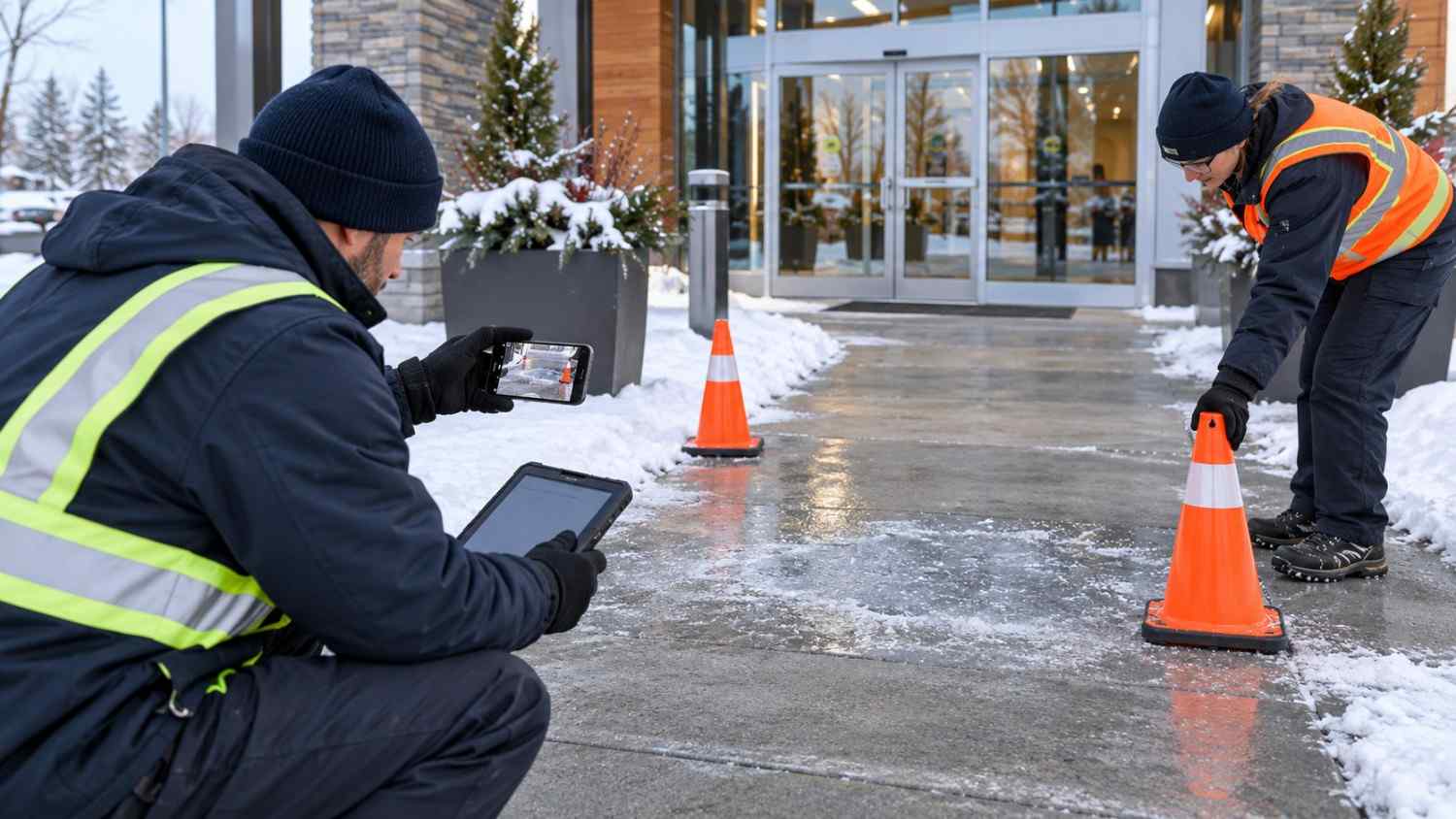
Winter freeze events can create operational, safety and property risks across commercial facilities. Frozen pipes, failed heating systems, blocked access routes, damaged building components and water releases can disrupt operations quickly, particularly when a facility has limited staffing or sits in a remote location.
For multi-site organisations, freeze protection also creates a governance challenge. A facility director may oversee properties in Ontario, Alberta, British Columbia and Québec, while each site operates under different building requirements, climate conditions, contractors and provincial rules.
At Facility Network, we approach these challenges through standardised facility processes, preventive maintenance planning and coordinated service delivery. With more than 40 years of experience, support for 10,000+ facilities across 2,500 cities and towns as stated on our About page, and coast-to-coast coverage through a single point of contact, we understand why consistent winter controls need to work alongside local site requirements.
Commercial building freeze protection should therefore be treated as an ongoing risk-control process rather than a one-time winter inspection. The strongest approach connects asset identification, preventive schedules, service ownership, escalation procedures, documentation and verification.
Canadian facility teams should treat freeze protection as a coordinated programme that identifies vulnerable building systems, establishes preventive maintenance activities, assigns clear ownership and verifies that critical controls remain operational throughout winter.
A practical programme should address:
The exact requirements depend on the building, its systems, occupancy, jurisdiction and applicable codes.
The National Building Code of Canada 2025 is a national model code developed by the Canadian Board for Harmonized Construction Codes and published by the National Research Council of Canada. It does not automatically become law everywhere when published. Provinces and territories adopt or adapt national model codes through their own regulatory processes. NRC specifically advises building owners and professionals to confirm the applicable requirements with the relevant provincial or territorial authority.
That distinction is essential when developing a Canadian freeze protection programme.
Before establishing winter maintenance schedules, facility teams should identify where freezing conditions could cause the greatest operational impact.
The assessment should consider:
Not every pipe or mechanical component presents the same level of risk.
A water line serving a critical operational area may require a different control strategy from a low-consequence system in a conditioned space. Facility teams should therefore classify assets according to both their likelihood of freezing and the potential consequence of failure.
This creates a foundation for facility risk controls that can be applied consistently across a portfolio.
Freeze protection becomes difficult to manage when teams do not know which assets require seasonal attention.
A winter asset register can identify:
The register should connect to the facility's broader asset management system where possible.
This is where facility management technology and real-time visibility can support multi-site teams. When asset information, work orders and inspection records are connected, managers can more easily identify which facilities have outstanding winter tasks.
A freeze protection plan can fail even when the technical controls are appropriate if nobody clearly owns the activity.
Each critical control should have an accountable role.
For example:
Facility manager: Owns site-level readiness and escalation.
Maintenance team: Performs inspections and corrective work.
Building operator: Monitors operating conditions and reports abnormalities.
Contractor: Performs defined specialist or scheduled services.
Regional manager: Coordinates issues that affect multiple locations.
Risk or compliance team: Reviews documentation, controls and exceptions.
Emergency response team: Coordinates urgent events that exceed normal maintenance capacity.
Scope ownership should also define what happens outside normal operating hours.
If a temperature alarm occurs at 2:00 a.m. on a Saturday, the system should not simply generate an alert without identifying who receives it and what action follows.
Preventive maintenance planning should begin before the coldest period, not after the first freeze-related failure.
A winter schedule can include:
The timing should reflect the asset and the local climate.
For example, a facility in northern Alberta may require readiness activities earlier than a property in southern British Columbia. A coastal facility may experience wet conditions and freeze-thaw cycles that create different risks from prolonged deep cold.
A national schedule can establish the governance framework while allowing regional teams to adjust timing according to local conditions.
A common mistake in multi-site maintenance is giving every building the same winter response standard.
A better approach establishes service categories based on risk.
For example:
A condition that could affect a critical building system, significant property function or essential operation.
Response: Immediate escalation according to the site's emergency procedure.
A condition that could develop into a significant freeze-related failure if not addressed promptly.
Response: Priority maintenance assignment and documented follow-up.
A preventive or minor condition that should be addressed within the planned maintenance programme.
Response: Scheduled work order and completion verification.
These categories should be defined in the organisation's own operating procedures. They should not be presented as universal legal classifications.
This type of structure supports operational consistency because facility teams can apply the same decision framework while adjusting thresholds to individual buildings.
Temperature monitoring can provide an additional layer of visibility, particularly in remote or high-risk areas.
Depending on the building, teams may monitor:
However, monitoring should be treated as one control rather than a complete freeze protection solution.
A sensor may detect a temperature decline, but the facility still needs an escalation pathway, someone responsible for reviewing the alert and a documented response.
A useful process is:
Monitor → Alert → Assess → Escalate → Correct → Verify → Close
This sequence should be incorporated into the site's work-order and emergency procedures.
Heating and monitoring systems can depend on electrical power.
That creates an important connection between freeze protection and business continuity planning.
A winter outage can affect:
A facility may therefore have a technically sound freeze plan but still be vulnerable if a power interruption disables its supporting systems.
Where backup power is part of the facility's strategy, teams should document which loads require support and how the backup system is tested.
Freeze protection is not limited to mechanical equipment.
The building envelope can influence indoor temperatures, moisture conditions and exposure to cold air.
During seasonal inspections, teams can look for:
A recurring cold spot may indicate a building envelope issue rather than a heating system failure.
Documenting these observations can help distinguish immediate maintenance needs from longer-term capital requirements.
Freeze protection becomes more complex when facilities are remote.
A rural site may have:
This can change the appropriate service frequency and escalation plan.
A national programme should therefore avoid assuming that every site can receive identical response support.
Instead, facility teams should document local service capacity and establish contingency options where travel delays could increase exposure.
Canadian facility governance requires careful attention to jurisdiction.
The National Building Code of Canada 2025 is a model code. Provinces and territories determine how national model codes are adopted or adapted, and local authorities may have additional requirements. NRC states that the applicable provincial or territorial authority should be contacted to determine which codes and regulations apply.
This means a national freeze protection policy should include a jurisdictional review rather than simply stating that every facility follows the NBCC 2025.
The review can identify:
The authority having jurisdiction should be the final reference for applicable code and regulatory requirements.
Freeze protection work can involve mechanical rooms, ladders, electrical equipment, confined or restricted spaces, winter travel and other workplace hazards.
For federally regulated workplaces, Part II of the Canada Labour Code establishes occupational health and safety requirements. The federal government states that these provisions apply to federally regulated workplaces and place duties on employers and employees relating to workplace health and safety.
The Canada Labour Code does not apply to every commercial building in Canada. Organisations outside federal jurisdiction generally need to follow the applicable provincial or territorial occupational health and safety framework. Canada.ca identifies provincial and territorial employment and workplace requirements for organisations that are not federally regulated.
Facility teams should therefore identify the jurisdiction applicable to each site before establishing contractor or employee safety procedures.
Contractors may perform important freeze protection activities such as heating maintenance, plumbing work, insulation repairs, emergency response and inspections.
Before winter begins, facility teams should verify the documentation required under their contracts and applicable jurisdiction.
Depending on the work and province, this can include:
Requirements differ by jurisdiction and type of work.
For example, Ontario's WSIB provides clearance numbers that show a registered business, contractor or subcontractor is registered and up to date with WSIB requirements. The current WSIB guidance states that clearances are valid for up to 90 days.
Facility teams should not assume that a WSIB process applies identically in British Columbia, Alberta or Québec. WorkSafeBC, WCB Alberta, CNESST and other provincial systems have their own requirements and terminology.
Maintenance documentation should show more than a work order marked "complete".
For important freeze protection activities, useful records can include:
The objective is to establish a clear operational history.
For example:
Weak record:
“Heating checked.”
Stronger record:
“Mechanical room heating system inspected. Thermostat response verified. No visible pipe insulation damage observed. Temperature monitoring active. No corrective action required.”
The second record provides much more useful information for future maintenance planning.
Preventive schedules cannot account for every winter event.
Facility teams should define escalation procedures for conditions such as:
Each exception should have an owner and a next action.
A simple escalation model could be:
Site team → Regional operations → Specialist contractor → Emergency response → Senior risk escalation
The actual structure should reflect the organisation's size, facility type and operating model.
For urgent facility conditions, 24/7 emergency facility services can form part of a broader escalation strategy where emergency response capability is required.
Once winter inspections and work orders follow a consistent structure, facility teams can analyse the information across their portfolio.
Useful questions include:
These insights support facility governance Canada strategies by giving leadership a clearer view of where operational controls are working as intended and where additional attention may be required.
Analytics should support investigation rather than produce simplistic pass or fail conclusions.
A high number of work orders, for example, could reflect strong reporting practices rather than poor maintenance.
Canadian winter risk management should not focus exclusively on the temperature forecast.
Depending on the region, facility teams may need to consider:
These conditions can affect staffing, contractor availability and service levels.
The programme should therefore include contingency planning for circumstances where the normal preventive schedule cannot be completed on time.
A multi-site organisation does not necessarily need completely different winter processes at every property.
A better governance structure can establish common requirements for:
Local teams can then add site-specific requirements for climate, equipment, municipal rules and operational risk.
This balance supports multi-site maintenance standards without forcing every facility into an identical operational model.
It also makes national service delivery easier to manage because leadership can compare information using common categories while still recognising regional differences.
Before the winter season, facility teams can use a structured review such as:
At Facility Network, we understand that freeze protection across a Canadian portfolio requires more than a seasonal checklist.
We focus on combining coordinated maintenance services, structured processes and operational visibility so teams can manage preventive tasks, corrective work and escalation through a consistent framework.
Our experience spans more than 40 years, and our About page states that we support more than 10,000 facilities across 2,500 cities and towns. We also provide coast-to-coast coverage through a single point of contact.
Our commercial facility maintenance services can support organisations that need winter maintenance integrated with broader facility operations rather than managed as an isolated seasonal activity.
The approach can also connect preventive work with documentation, service ownership and portfolio-level visibility. For organisations reviewing their broader operating model, our facility services by industry resources provide additional context for different facility environments.
Commercial building freeze protection works best when it forms part of a documented facility governance programme.
The practical foundation is straightforward: identify vulnerable assets, establish preventive schedules, assign clear ownership, define escalation paths, verify completed work and maintain documentation that supports operational review.
Canadian facility teams should also recognise that building codes, occupational health and safety requirements, permits, inspections and contractor obligations can vary by jurisdiction. The National Building Code of Canada 2025 is a national model code, not an automatic replacement for locally adopted requirements. NRC directs users to the relevant provincial or territorial authority to determine which codes and regulations apply.
At Facility Network, we help organisations bring maintenance planning, service coordination and operational visibility together across complex facility portfolios. You can contact Facility Network to discuss the winter maintenance requirements of your facilities.
What is commercial building freeze protection?
Commercial building freeze protection is the planned process of identifying and managing conditions that could cause freezing, heating failure, water damage or disruption to vulnerable building systems. It can include preventive maintenance, temperature monitoring, insulation inspections, heating system checks, emergency procedures and documented verification.
Why is freeze protection important for Canadian commercial buildings?
Canadian facilities can experience prolonged cold, freeze-thaw cycles, freezing rain, heavy snow and winter access disruptions. These conditions can affect heating systems, exposed piping, building envelopes and other vulnerable assets. A structured programme helps facility teams identify risks and establish preventive and corrective controls.
Does the National Building Code of Canada 2025 automatically apply to every commercial building?
No. The National Building Code of Canada 2025 is a national model code. Provinces and territories adopt or adapt national model codes through their own regulatory processes. The applicable authority should be consulted to confirm the code edition and requirements in a specific location.
Does the Canada Labour Code apply to every commercial facility?
No. Part II of the Canada Labour Code applies to federally regulated workplaces. Other workplaces generally fall under applicable provincial or territorial occupational health and safety legislation. Facility teams should determine the jurisdiction applicable to each site.
What should be included in a freeze protection maintenance schedule?
A schedule can include heating system inspections, temperature monitoring checks, pipe insulation reviews, mechanical room inspections, building envelope checks, loading-door inspections, drainage reviews and backup power dependency checks. The exact schedule should reflect the building and its assets.
How should multi-site organisations manage freeze protection across Canada?
Organisations can establish common governance standards for asset classification, preventive maintenance, documentation, escalation and verification while allowing individual facilities to adjust controls for climate, equipment, municipal requirements and local operating conditions.
Why is maintenance documentation important for freeze protection?
Maintenance documentation creates a record of inspections, findings, corrective actions and verification. Consistent records can help managers identify recurring problems, track overdue work and understand the maintenance history of critical assets.
What contractor documents should facility teams review?
Depending on the work and jurisdiction, teams may review insurance, workers' compensation registration or clearance, licences, training records, safety procedures, subcontractor information and service documentation. Requirements should be confirmed for the specific province and type of work.
How can facility management technology support freeze protection?
Facility management technology can connect assets, work orders, preventive schedules, service records and escalation information. This can improve visibility across multiple properties and help managers identify outstanding tasks or recurring issues.
How often should a commercial freeze protection programme be reviewed?
The programme should be reviewed before each winter season and whenever significant changes occur, such as a building renovation, equipment replacement, change in occupancy, new contractor, regulatory update or significant winter event. The review frequency should reflect the facility's risk profile and operational requirements.